Inverter monitoring Software vs Independent Platforms?
Inverter software only shows you part of the picture. Discover why independent solar monitoring platforms deliver true plant-wide visibility, SCADA-level control, and WAMS capabilities that inverter portals simply cannot match.
Most solar plant owners start with the free monitoring portal that comes with their inverters. It feels convenient. It shows production numbers. It sends basic alerts. But that convenience comes at a quiet cost.
Inverter software is designed around one brand’s equipment. It was never built to see the rest of the plant, trackers, meters, weather stations, transformers, batteries, or string-level issues outside its own ecosystem. Over time, this limited view turns into slower fault detection, incomplete performance analysis, and zero ability to actually monitor or control the plant as a system.
Independent monitoring platforms were built for a different purpose: full plant visibility and control. The best of them function as modern SCADA and WAMS systems, not just dashboards. They connect multiple brands and equipment types, give operators real command capability, and turn scattered data into actionable plant intelligence.
Limitations of the inverter’s native software
If you currently depend only on your inverter’s software, the gap between what you see and what is actually happening on site is larger than most operators realize.
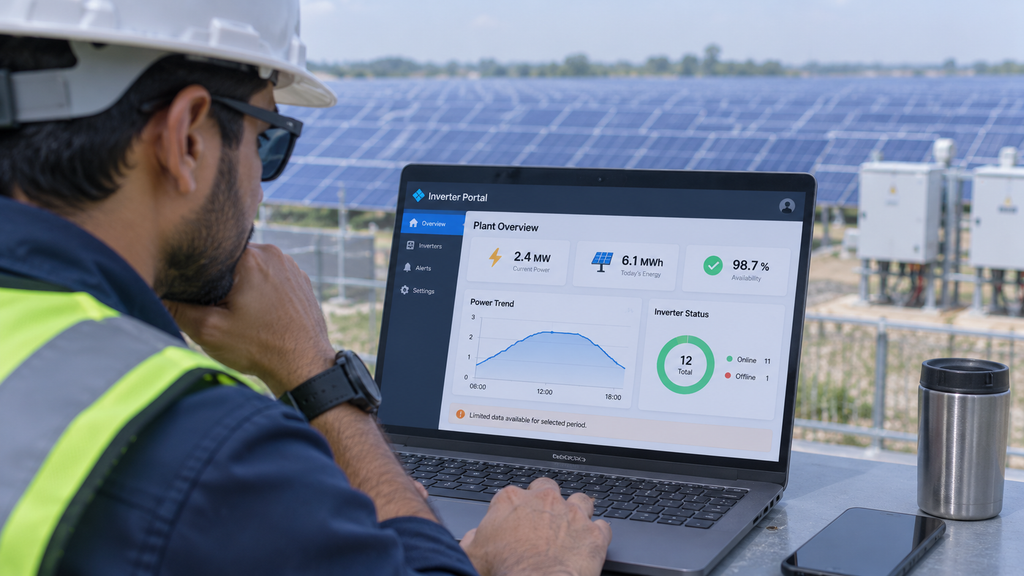
Inverter portals reporting what their own devices are doing. They are fast to set up and familiar, but they remain brand-locked, monitoring-only tools with limited data ownership and almost no control functions.
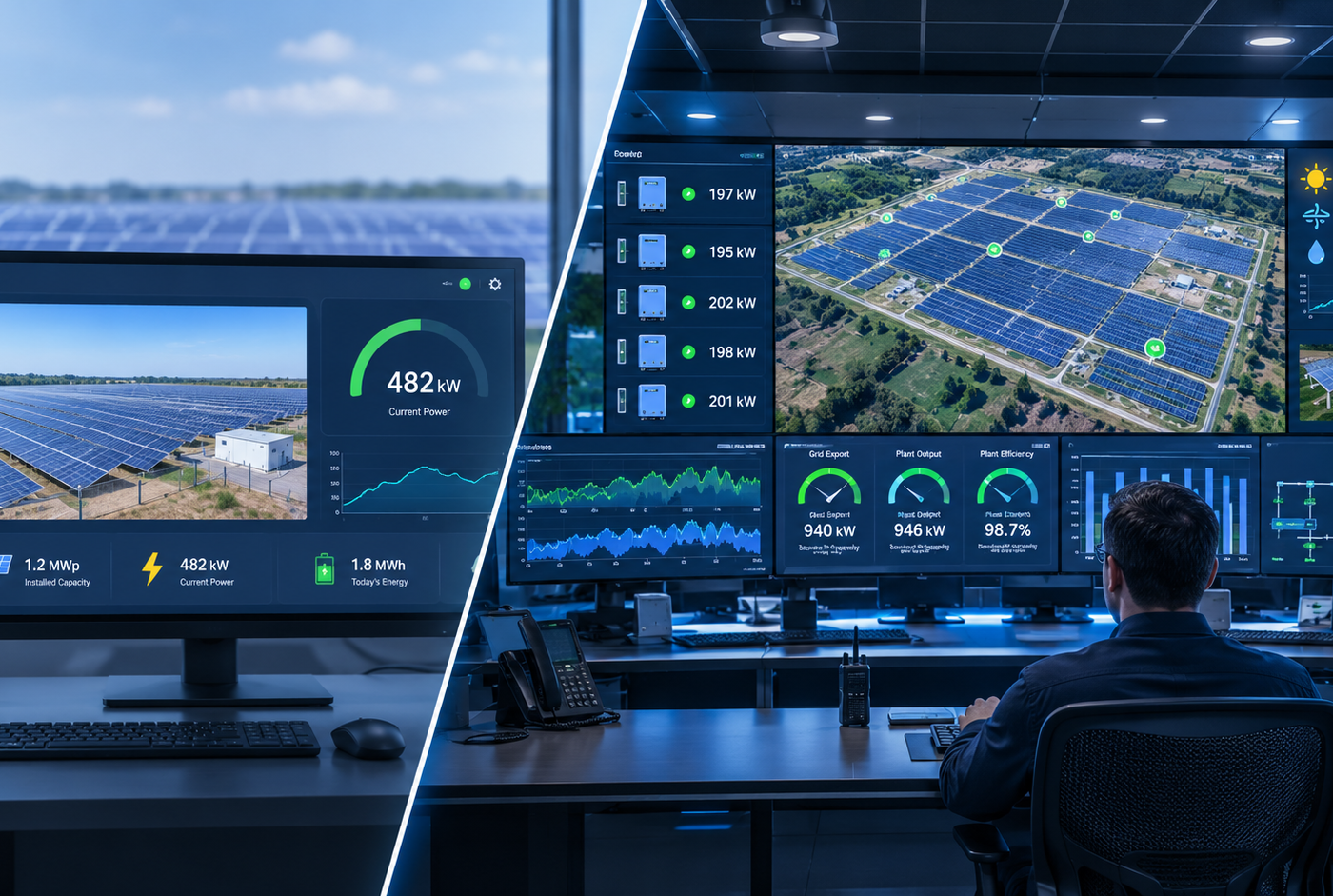
Independent platforms start from the opposite philosophy. They treat the entire plant as the system. They support multiple inverter brands and other critical equipment, deliver high-resolution data, enable remote control actions, and scale into full SCADA/WAMS functionality. The result is not just better monitoring. ]t is the ability to operate and optimize the plant as a coherent asset rather than a collection of separate devices.
Inverters software built for commissioning phase
Inverter monitoring software is built for a narrow job: confirming that the device itself is working during commissioning and the early handover period. It is not designed for continuous plant operation.
Most manufacturers cannot store high-resolution data in short time frames on their cloud platforms. As a result, what you normally see online is aggregated or macro-level information. Detailed real-time values or fine-grained historical data are usually only available locally through a dongle, direct cable connection, or the manufacturer’s local software. The limitation is not accidental. It comes from constraints in online storage capacity and data processing power that are deliberately kept at the level of a single device.
This design makes sense for the commissioning phase. You connect the inverter, run basic checks, verify that it is healthy, and monitor it for a short period to ensure there are no immediate faults. Once the plant moves into long-term operation, the requirements change completely. You need to observe multiple parameters at short intervals, detect deviations quickly, and continuously optimize performance. A tool created for startup and basic health checks cannot meet those demands.
Inverter Software only built for device, not for Solar Ecosystem
The same software also has almost no visibility beyond the inverter. A real solar plant contains many other devices: meters, weather stations, trackers, transformers, string combiners, switches, and sometimes batteries. The inverter portal has no access to most of them. Even the inverter itself should appear as only one element inside a complete plant dashboard, not as the entire monitoring system.
Additional functional limits become obvious in daily work. You cannot properly correlate production trends with environmental parameters, build intelligent detection algorithms, create highly specific custom alerts, or define structured operation plans. Visual tools for reviewing the full electrical layout in 2D or 3D are missing. Most critically, if the inverter itself fails or loses communication, the data stream stops. Yet the whole purpose of monitoring is to detect problems with the inverter and to compare its behavior before and after an event so the root cause can be identified.
When the only data source is the inverter, diagnosis becomes incomplete. You cannot cross-check its readings against the revenue meter or against cable and switch measurements. Without that cross-reference it is often impossible to know whether a drop in performance comes from the inverter, a metering error, a cable or connection issue, low irradiance, high temperature, or something else entirely.
The operational blind spots created by brand-locked monitoring
Because the native software is locked to one manufacturer’s ecosystem, large parts of the plant remain invisible. Operators see only what that brand’s devices choose to report. Any equipment from another supplier, any independent sensor, or any measurement point outside the inverter’s protocol simply does not appear.
This creates systematic blind spots. String-level anomalies that occur before the inverter, soiling or mismatch issues that affect only part of an array, tracker misalignment, transformer losses, or meter discrepancies all stay hidden or appear only as an unexplained drop in the inverter’s output. The software has no mechanism to bring those signals into the same view.
The single-point-of-failure problem compounds the issue. When monitoring depends on the inverter’s own communication channel, any hardware fault, firmware problem, or network interruption on that device also cuts the monitoring data. Operators lose the historical context needed to understand what changed and when. Independent platforms avoid this by collecting data from multiple sources in parallel, so the loss of one device does not black out the entire plant view.
In practice, plant owners and O&M teams end up switching between several manufacturer portals, exporting CSV files, and manually trying to align timestamps. The process is slow, error-prone, and still incomplete. The more brands and device types a site contains, the larger the visibility gap becomes.
What changes when monitoring becomes plant-wide SCADA and WAMS
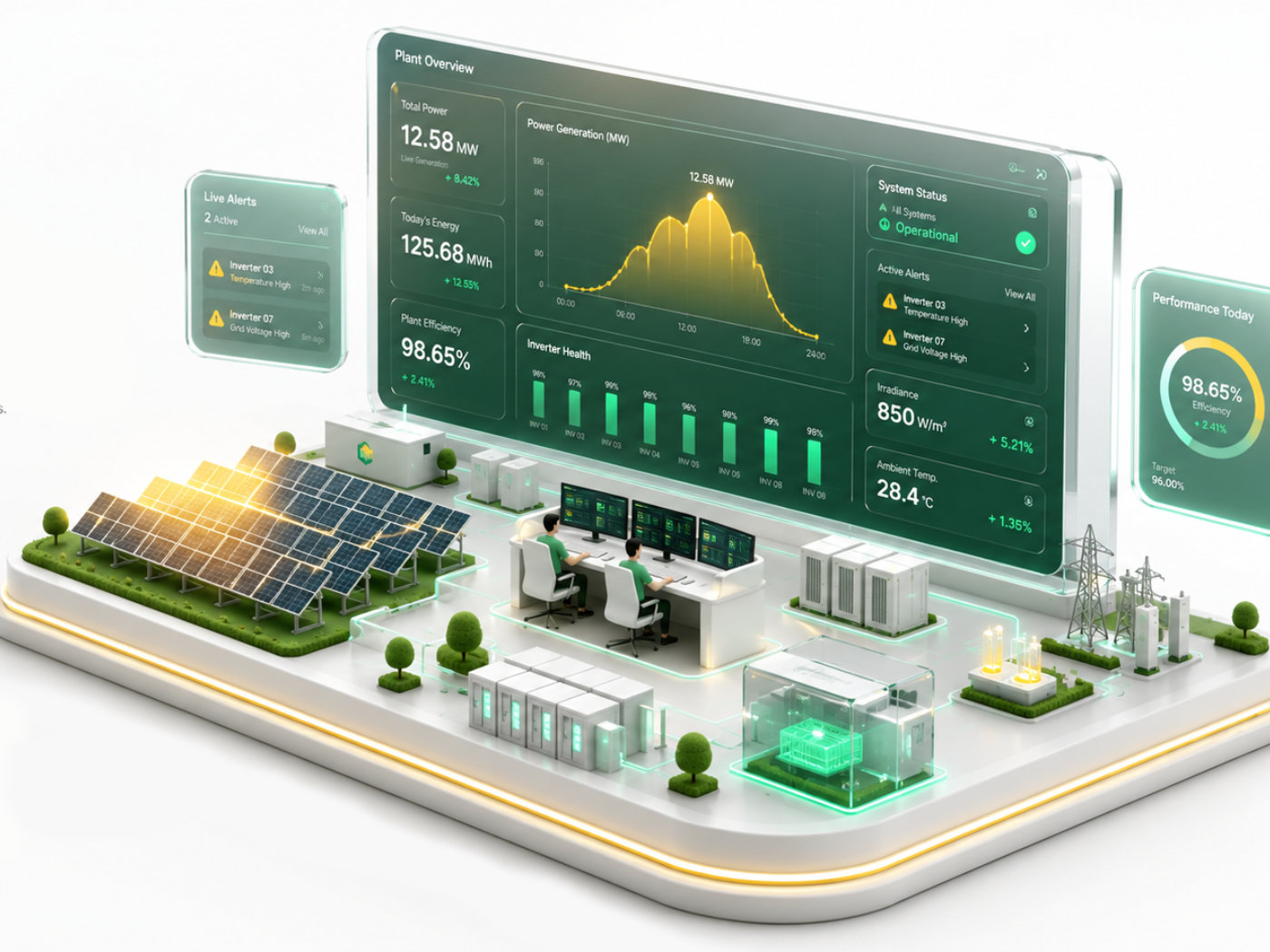
An independent monitoring platform treats the entire plant as a single system rather than a collection of separate brand portals. Inverters from different manufacturers, revenue meters, weather stations, trackers, and other equipment all feed into one coherent data layer.
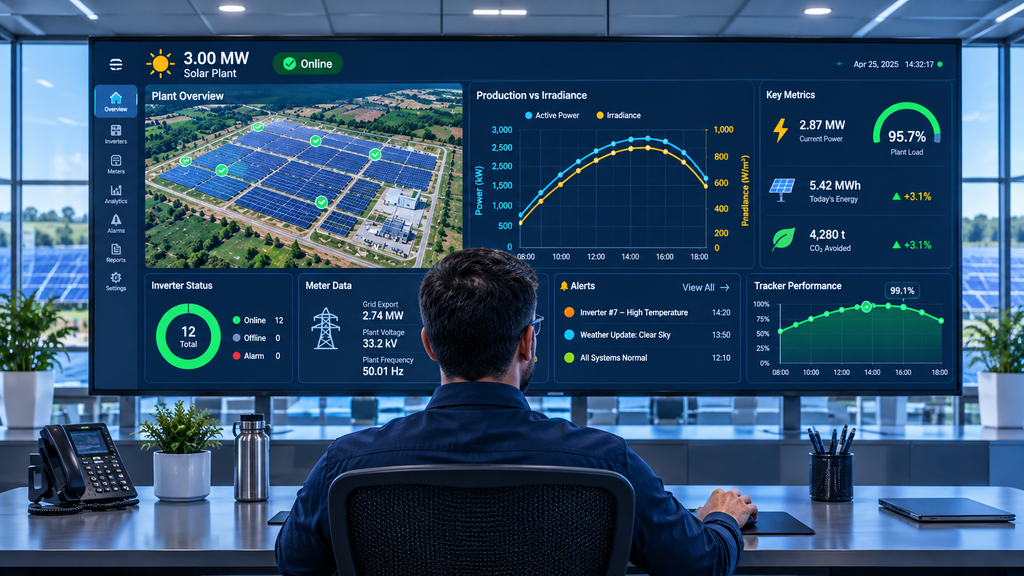
High-resolution data can be stored and processed continuously because the platform is not constrained by a single device’s storage and processing limits. Operators gain the ability to compare production against irradiance, temperature, and other environmental variables in the same interface. Custom alerts, performance ratios, and operational schedules become practical. Layout visualization and circuit-level views are possible. Most importantly, the platform continues to receive data from other sources even if one inverter fails, preserving the before-and-after context needed for accurate diagnosis.
At this level the system moves beyond simple monitoring. It starts to function as a modern SCADA environment with the potential to support wide-area monitoring (WAMS) capabilities across multiple sites or larger plants. Control actions, automated responses, and cross-device correlation become available instead of remaining locked inside a manufacturer’s closed portal.
The shift is fundamental: the inverter stops being the monitoring system and becomes one monitored asset among many. That change is what allows genuine operational optimization rather than periodic health checks.
What Professional Operators Actually Use
Professional operators do not treat the inverter portal as the plant’s monitoring system. They treat it as one data source among many. Independent platforms are built to collect, align, and act on signals from every critical asset on site (inverters of different brands, revenue meters, weather stations, trackers, transformers, and protection devices) inside a single operational layer.
At this level the platform functions as a practical SCADA system with the ability to support wider monitoring and control functions. High-resolution data is retained continuously. Production can be correlated against irradiance and temperature in real time. Custom alerts, performance thresholds, and operational schedules become usable tools rather than theoretical features. When one device fails, the rest of the data stream continues, preserving the context needed for diagnosis. The inverter is no longer the center of the system; it is simply one monitored asset.
Case Study: 3 MW Plant – Inverter Software Only vs Independent SCADA-Capable Platform
Consider a 3 MW commercial plant with three different inverter brands, a revenue meter, a weather station, and motorized trackers.
Scenario A – Relying only on the manufacturers’ portals
The O&M team monitors three separate cloud dashboards. High-resolution data is limited or available only locally. When output drops 8–12 % on a clear day, each portal shows its own inverters as “normal” or reports only a generic under-performance. There is no simultaneous view of the revenue meter, irradiance, or tracker positions. Cross-checking requires exporting files and aligning timestamps manually.
Risks that materialize:
A failing DC cable or loose connection on one string is invisible until the inverter eventually reports a larger fault or the monthly meter reading reveals the loss.
Tracker misalignment on part of the array is never correlated with production data, so the energy loss continues for weeks.
When one inverter loses communication, its entire historical window disappears from the cloud view, making before-and-after comparison impossible.
The team cannot set plant-wide rules (for example, “alert if any inverter under-performs relative to irradiance by more than 5 % for 30 minutes”). Diagnosis remains reactive and incomplete.
Over a year the cumulative undetected losses and delayed interventions reduce revenue and increase the chance of warranty disputes, because the data needed to prove root cause is fragmented or missing.
Scenario B – Independent platform acting as plant SCADA
The same plant feeds all inverters, the revenue meter, weather data, and tracker status into one system. When the same 8–12 % drop occurs, the platform immediately shows the mismatch between inverter output and meter reading, flags the specific string or tracker zone, and preserves high-resolution history even if one inverter goes offline. Operators receive a precise alert, locate the fault the same day, and restore performance. Monthly reconciliation between inverter data and the revenue meter becomes routine rather than a forensic exercise.
The difference is not cosmetic. It is the difference between discovering problems after they have already cost energy and catching them while they are still small.
Closing Perspective
Inverter software is adequate for confirming that a device is healthy at commissioning. It was never designed to operate a plant. The storage limits, single-device focus, lack of multi-equipment visibility, absence of real control functions, and single point of data failure make it unsuitable as the primary monitoring system once the plant enters commercial operation.
Independent platforms reverse that logic. They place the entire plant at the center. They retain the data resolution needed for daily optimization, support cross-device diagnosis, and scale into genuine SCADA and wider monitoring capabilities. For any site that must protect production, reduce downtime, and maintain clear operational records, moving beyond the inverter portal is no longer optional. It is the practical requirement of professional plant management.
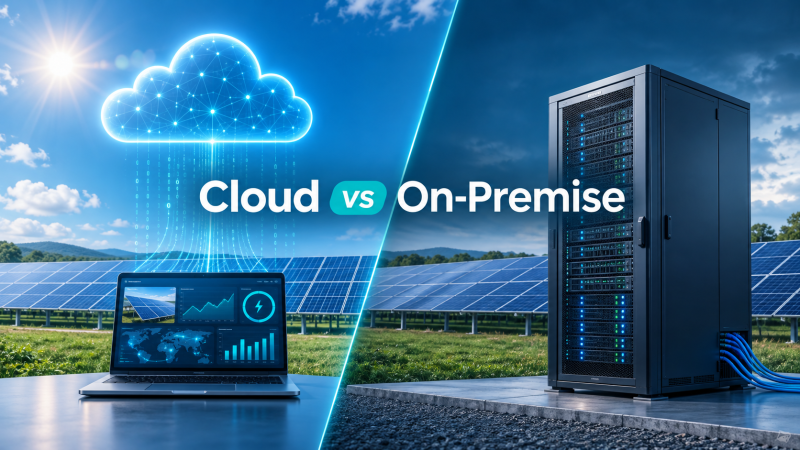
Choosing the right monitoring architecture is one of the most consequential decisions you’ll make for a solar plant. Cloud-based and on-premise systems both collect…
Write a comment