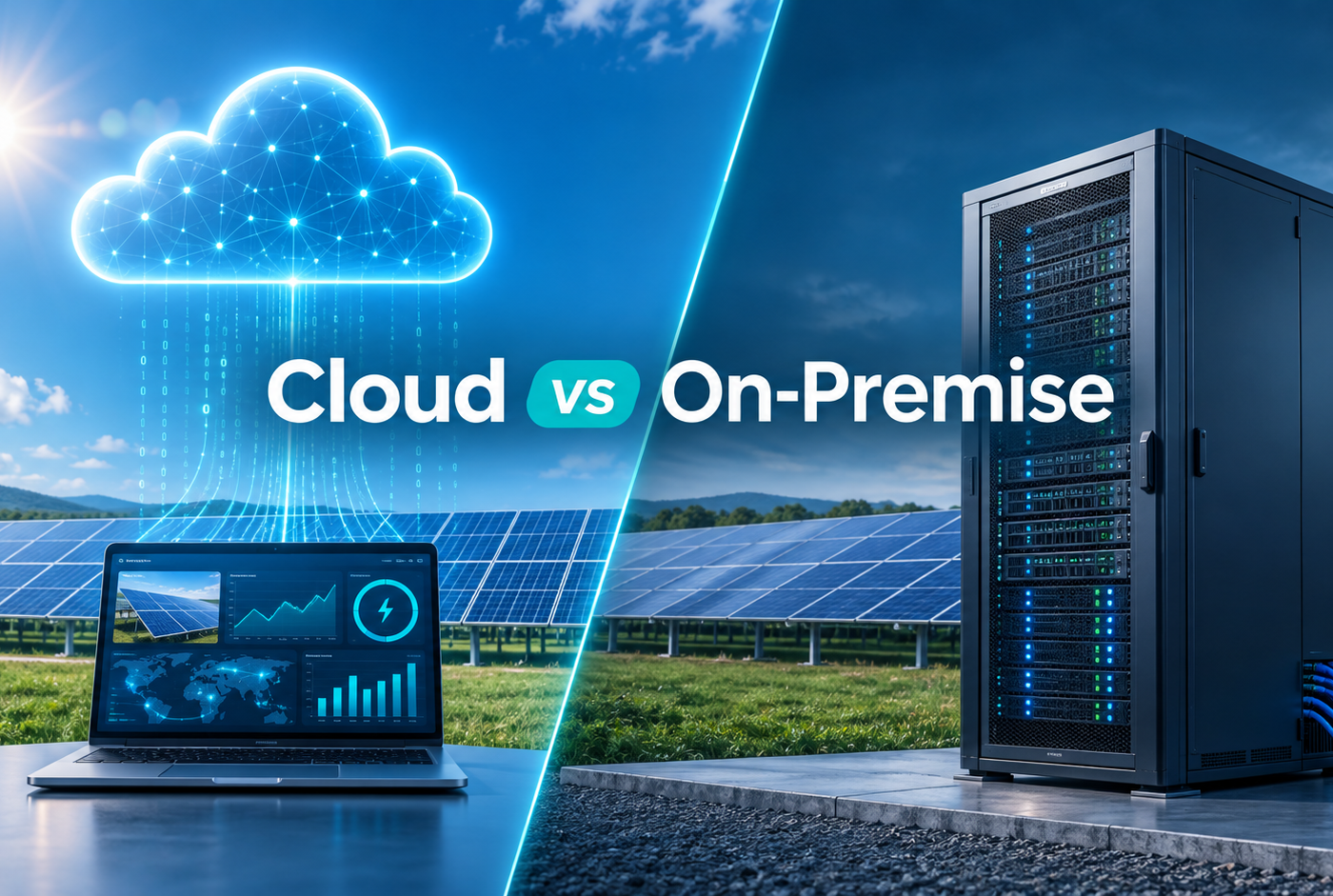
Cloud vs On-Premise Solar Monitoring: Which Fits Your Plant?
Choosing the right monitoring architecture is one of the most consequential decisions you’ll make for a solar plant. Cloud-based and on-premise systems both collect and display performance data, yet they differ fundamentally in where the data lives, who controls it, how it survives connectivity problems, and what it costs over the life of the asset.…
Choosing the right monitoring architecture is one of the most consequential decisions you’ll make for a solar plant. Cloud-based and on-premise systems both collect and display performance data, yet they differ fundamentally in where the data lives, who controls it, how it survives connectivity problems, and what it costs over the life of the asset. Understanding these differences early prevents expensive rework later and ensures your monitoring system actually supports plant performance and investor reporting.
The Core Requirements of Effective Solar Monitoring Software
At its heart, any solar monitoring platform must do three things exceptionally well: deliver data in near real time, store it accurately and securely for years, and turn that historical record into reliable analytical insight. Miss any one of these and the system stops being a management tool and becomes a source of risk.
Think of it the way a bank CEO would. If transaction data arrives even a few minutes late, liquidity positions become unclear, fraud detection lags, and regulatory reports lose credibility. Multiply those minutes across thousands of accounts and the potential damage is measured in millions. A solar plant operates under the same logic. A delayed alert on inverter clipping, a string outage, or a tracker failure can silently erode production for hours or days. Incorrect or incomplete storage means you cannot reconstruct what happened when an insurance claim or performance guarantee dispute arises. And without clean long-term data, you cannot run degradation analysis, compare actual versus expected yield, or prove asset value to lenders and secondary buyers. In short, monitoring is not a nice-to-have dashboard, it is the operational nervous system of the plant. Any architecture you choose must protect the speed, integrity, and analytical usefulness of that data above all else.
Cloud-Based Solar Monitoring
In a cloud deployment, the monitoring software and its database run in a remote data center. Authorized users can log in from anywhere in the world with an internet connection or only from head office, a laptop at the airport, or a smartphone on site. This convenience is powerful, but it introduces a single point of dependency: the plant’s internet connection.
If the site link drops or becomes congested, data may stop flowing to the cloud in real time. For plants where timely visibility matters, two safeguards are essential. First, install a secondary modem (usually cellular) that can take over automatically. Second, ensure the local data logger or edge device continues to buffer measurements and then uploads the backlog as soon as connectivity returns. Without these measures, you risk blind spots exactly when you need visibility most.
Security is generally strong in reputable cloud platforms. Data sits in professionally managed, redundant environments, and most providers allow you to whitelist specific IP addresses so that only approved networks can reach the system. The trade-off is ongoing cost: you pay a recurring fee for server resources and cloud storage, plus the cost of reliable site internet (and the backup link). For this reason, pure cloud architectures are typically recommended for projects up to around 10 MW, depending on location, internet reliability, and the criticality of the data. Beyond that size, or in regions with weaker connectivity, the economics and risk profile often shift toward a different approach.
On-Premise Solar Monitoring
An on-premise solution places both the software and the database on hardware that lives at the plant or in your own facility. You buy the server once ranging from a compact industrial mini-PC for smaller sites to a more robust server for larger portfolios and thereafter you own the platform outright. Because modern solar monitoring software is relatively lightweight when well optimized, most plants do not require heavy computing infrastructure. The decisive factor is the volume of data you intend to retain and the depth of analytics you plan to run locally.
As long as the on-site hardware has internet access, you can still view the system remotely through a fixed IP address or a domain name. The critical advantage appears when the connection fails: data continues to be recorded and stored on the local machine. Only remote viewing is interrupted. The moment connectivity is restored, full access resumes and the historical record remains complete. This local resilience is the strongest argument for on-premise deployments, especially for plants where continuous data integrity outweighs the convenience of pure cloud access.
Head-to-Head Comparison
Selecting the right infrastructure is not just a technical decision, it directly affects cost, data ownership, operational resilience, and long-term scalability. Modern solar monitoring platforms like Nexun are deliberately designed to be hardware-independent. The same software capabilities, communication protocols, cybersecurity features, and user experience are available whether you choose a cloud-hosted or on-premise deployment. This flexibility lets plant owners match the architecture to project size, cybersecurity policy, and operational philosophy without sacrificing functionality.
Cloud Hosting (Typically Suitable up to 10 MW)
For small and medium-sized plants, cloud deployment removes the need for any dedicated on-site server hardware. The platform runs in a secure remote environment and can be accessed from anywhere with proper authorization.
Two common approaches exist:
Dedicated Cloud Infrastructure : Isolated virtual resources reserved exclusively for your plant. This model is preferred when higher performance isolation, stricter regulatory compliance, or elevated availability is required. It can be hosted on major providers such as Microsoft Azure, AWS, Google Cloud, Oracle Cloud, or specialist providers, or even inside a customer’s own private cloud.
Shared Cloud Infrastructure : Computing resources are efficiently shared across multiple independent installations while maintaining complete logical separation of customer data. This option significantly lowers cost and is particularly well suited to commercial rooftop systems, distributed generation portfolios, small utility-scale plants, pilot projects, and demonstration facilities.
Key practical advantages of the cloud model include:
No on-site server hardware to purchase or maintain
Lower initial infrastructure investment
Automatic software updates and centralized administration
Secure remote access from any authorized location
Flexible resource scaling and simplified disaster recovery
Rapid deployment (often requiring only a fixed IP address at the plant)
Typical commercial pricing for cloud hosting sits in the range of $20–$50 per month, depending on the provider and the exact resource allocation. The main ongoing costs are the cloud subscription itself and reliable site internet (plus a recommended backup cellular modem for critical plants).
Local Deployment Solar Software
For larger utility-scale plants, electrical substations, critical infrastructure, or projects with strict data-sovereignty or cybersecurity requirements, the platform can be installed entirely inside the customer’s own network. All application services, databases, historical archives, and communication gateways remain under the owner’s full control.
Because the software has been optimized for efficiency, expensive enterprise servers are rarely required. In many cases a standard business-class computer is sufficient:
Intel Core i5 or i7 (10th generation or newer)
16 GB RAM and 1 TB storage
Linux (Ubuntu recommended)
Static IP address for secure remote access
For larger or high-availability sites, redundant servers, virtualization platforms, or clustered databases can be added according to the customer’s reliability targets.
The decisive operational advantage of on-premise deployment is independence from external internet connectivity. Data acquisition, historical logging, alarm management, reporting, and local operator functions continue uninterrupted even if the site internet link is lost. Only remote viewing is temporarily affected; once connectivity returns, full access resumes and the historical record remains complete. Remote access, when required, can be provided through a secure static IP, VPN, or any customer-approved remote-access solution without impacting normal plant operation.
Matching the Model to the Plant
Cloud deployment is generally preferred when rapid implementation, minimal capital expenditure, and simplified administration are the priorities. On-premise deployment is typically selected for larger plants or mission-critical facilities that demand complete data ownership, local operational independence, or strict compliance with internal cybersecurity policies.
Because both models share the identical software architecture, migration between cloud and on-premise environments remains possible as operational needs evolve without requiring a complete system redesign. This infrastructure flexibility ensures that the monitoring platform can grow with the asset while protecting the three non-negotiable requirements established earlier: timely visibility, accurate long-term storage, and reliable analytical insight.
Conclusion: Matching the Right Architecture to Your Plant
Choosing between cloud and on-premise solar monitoring is ultimately a decision about control, resilience, cost structure, and operational priorities. Both models deliver the same core software capabilities when built on a modern, hardware-independent platform. The difference lies in where the data lives, how the system behaves during connectivity issues, and how costs are distributed over the life of the asset.
The table below summarizes the practical trade-offs:
Criteria
Cloud Monitoring
On-Premise Monitoring
Typical Plant Size
Up to ~10 MW
Above 10 MW / utility-scale
Hardware Requirement
None on site
Standard PC (Core i5/i7) or industrial server
Initial Investment
Low
Higher (one-time hardware)
Ongoing Costs
Monthly cloud fee + internet
Minimal (mainly power & maintenance)
Data Ownership
Provider-managed (with isolation options)
Full local ownership
Behavior During Internet Loss
Requires local buffering + backup modem
Continues logging and local operation uninterrupted
Remote Access
From anywhere
Via static IP / VPN when needed
Best Suited For
Commercial, distributed, and mid-size plants
Large plants, critical infrastructure, strict data policies
Scalability & Updates
Easy and automatic
Controlled by the owner
In short: if your priority is speed of deployment, lower capital outlay, and simplified administration, cloud is usually the smarter starting point. If continuous local operation, complete data sovereignty, and independence from external connectivity matter most, on-premise is the stronger long-term choice. Many owners also begin with cloud and later migrate to on-premise as the portfolio grows — a transition that remains straightforward when the underlying software architecture is the same.
The right monitoring system does not just display numbers. It protects production, supports compliance, and turns operational data into clearer decisions. Choose the infrastructure model that aligns with how your plant actually operates, and the rest of the value follows.

Write a comment